RFID in Healthcare India: Patient Safety and Asset Tracking
What is RFID in Healthcare?
RFID in healthcare India refers to the application of Radio Frequency Identification technology inside hospitals, clinics, diagnostic centres, and pharmaceutical facilities to automate the tracking of patients, medical assets, surgical instruments, and clinical inventory in real time.
By attaching RFID tags to wristbands, equipment, or medicine packages, healthcare providers gain instant visibility over everything that moves within their facility — without manual scanning or paperwork.
Companies like Salvonic, a leading Indian manufacturer of RFID tags and readers, help healthcare organisations deploy reliable, locally built RFID systems that integrate seamlessly with hospital information platforms and ERP systems.
Understanding how this technology is transforming patient safety, equipment utilisation, and clinical operations is essential for hospital administrators, procurement heads, and healthcare technology decision-makers across the country.
RFID in Healthcare India: Introduction
Introduction
India’s healthcare sector is undergoing rapid digital transformation. With over 70,000 hospitals and lakhs of diagnostic facilities nationwide, the challenge of managing patients, assets, and medication safely and efficiently has never been greater.
The India healthcare RFID market is projected to grow at a CAGR of 20.9% through 2030, reaching USD 672 million — driven by hospital infrastructure investment, patient safety mandates, and the push toward smart hospital models.
Institutions like the All India Institute of Medical Sciences (AIIMS) have already begun integrating RFID into their operational workflows, setting the precedent for nationwide adoption.
This guide covers the key use cases of RFID technology in Indian hospitals — from hospital asset tracking RFID programmes and patient tracking system India deployments to pharmaceutical inventory control — and how manufacturers like Salvonic support end-to-end implementation.
RFID in Healthcare India: Key Applications and Use Cases
1. Patient Tracking and Safety Management
Real-time patient identification and movement tracking is one of the most impactful applications of RFID technology in Indian hospitals.
A robust patient tracking system India hospitals are deploying prevents critical errors such as wrong-patient medication, surgical misidentification, and transfusion mix-ups.
Key benefits for patient safety:
- Real-time patient location across wards, OTs, and ICUs
- Automated alerts when patients move to restricted zones
- Accurate medication verification at the point of care
- Improved infant and elderly patient security
- Faster emergency response through instant patient location retrieval
2. Hospital Asset Tracking and Equipment Management
Hospital asset tracking RFID is one of the most financially justified use cases for Indian hospitals.
Medical equipment — infusion pumps, ventilators, ECG machines, wheelchairs, and surgical instruments — represents crores of rupees in capital investment.
What hospitals gain from RFID asset tracking:
- Elimination of time wasted searching for misplaced equipment
- Reduced unnecessary procurement
- Automated preventive maintenance
- Tamper and theft alerts for high-value medical devices
- Accurate fixed-asset registers for audits
3. Pharmaceutical Tracking and Inventory Management
Medication management is among the most regulation-sensitive areas of hospital operations.
RFID-based healthcare inventory management RFID systems address dispensing errors, expired stock, and counterfeit drugs by tagging individual medicine packages and blood bags.

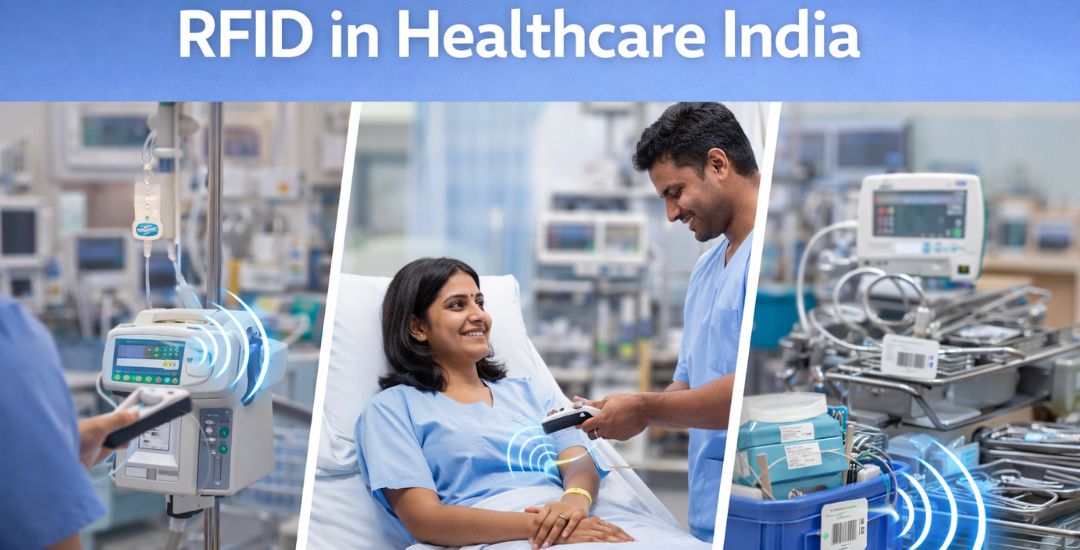
Hospitals use RFID in healthcare India |

RFID in healthcare India helps hospitals locate medical equipment |
RFID delivers the following in pharmacy and inventory:
- Automated stock counting without manual inventory cycles
- Real-time expiry monitoring
- Complete audit trail for controlled drug dispensing
- Anti-counterfeit verification
- Seamless integration with hospital pharmacy systems
How RFID in Healthcare India Works: Technology Overview
RFID Tags
Passive or active RFID tags are attached to patients, medical assets, or medicine packaging.
RFID Readers
Fixed readers capture tag data automatically while handheld readers are used by staff for audits and medication verification.
Middleware and Integration
RFID middleware filters tag reads and integrates them with Hospital Information Systems (HIS) and Electronic Medical Records (EMR).
Alerts and Analytics
The system generates automated alerts for missing assets, expiring inventory, and unauthorised movement.
Salvonic’s product range — including the BOLT 61 and BOLT 62 handheld UHF RFID readers and FLASH integrated readers — provides hospitals with a complete hardware ecosystem.

Conclusion
The adoption of RFID technology is rapidly becoming a mainstream operational standard across Indian hospitals.
From patient tracking system India deployments that prevent care errors to comprehensive hospital asset tracking RFID programmes that eliminate equipment loss, RFID delivers measurable improvements in patient safety and operational efficiency.
Hospitals ready to begin their RFID journey can partner with Salvonic — India’s trusted RFID hardware manufacturer — to deploy scalable, reliable systems tailored for healthcare environments.
Frequently Asked Questions
What is RFID in healthcare and how is it used in Indian hospitals?
RFID in healthcare tracks patients, medical assets, instruments, and pharmaceutical inventory in real time using RFID tags and readers.
How does hospital asset tracking RFID work?
RFID tags are attached to medical equipment and read automatically by fixed readers or handheld devices to track location and usage.
Which hospitals in India are using RFID in 2025?
Hospitals including AIIMS Delhi, AIIMS Bhopal, Apollo Hospitals, and Fortis have implemented RFID-based asset and patient tracking systems.
Ready to Transform Your Hospital’s Operations with RFID?
Partner with Salvonic to deploy industry-grade RFID solutions for patient safety, asset tracking, and healthcare inventory management.