RFID in Manufacturing India: A Complete Guide for Indian Industries
What is RFID in Manufacturing?
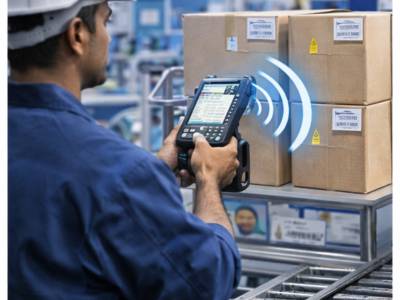
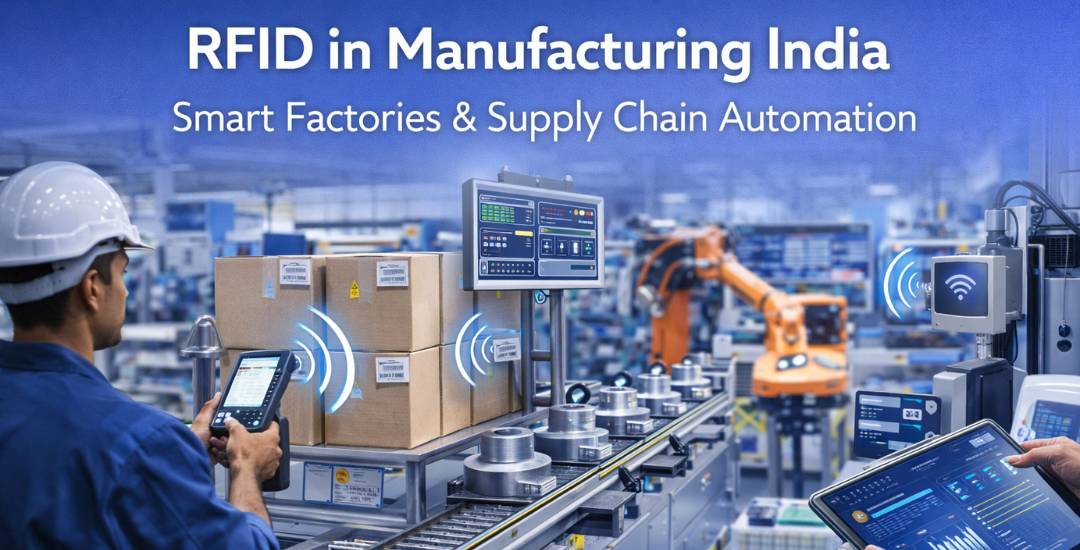
RFID in manufacturing India refers to the deployment of Radio Frequency Identification technology across production facilities, assembly lines, warehouses, and supply chains to automate the tracking of raw materials, work-in-progress components, finished goods, tools, and manufacturing assets. By tagging every significant item with an RFID label or hard tag, manufacturers gain real-time visibility over their entire production and logistics operation — eliminating manual data entry, reducing production errors, and accelerating supply chain throughput.
Companies like Salvonic, a leading Indian manufacturer of UHF RFID tags and readers, provide automotive, pharmaceutical, FMCG, and industrial manufacturers with domestically built RFID hardware engineered for the demanding conditions of Indian factory floors.
Understanding how RFID is transforming Indian manufacturing is critical for plant heads, supply chain directors, operations managers, and industrial technology buyers seeking to build smarter, leaner, and more competitive production operations.
RFID in Manufacturing India: Why It Is a Strategic Priority in 2025
Introduction
India is the world’s third-largest manufacturing economy and a key beneficiary of global supply chain diversification from China. The Production Linked Incentive (PLI) scheme across sectors — electronics, automotive, pharmaceuticals, textiles, and food processing — is driving unprecedented capital investment in Indian manufacturing capacity.
But capital investment alone does not deliver competitiveness. Operational excellence — lean production, zero-defect quality, and agile supply chain response — is the differentiator. RFID is the enabling technology that makes operational excellence achievable at scale. From automating RFID for production line work-in-progress tracking to enabling end-to-end supply chain automation RFID visibility, the technology directly addresses the efficiency and traceability gaps that hold Indian manufacturers back in global supply chain benchmarking.
This guide covers every major application of RFID across Indian manufacturing sectors, explains how the technology works in industrial environments, and provides a procurement framework for evaluating the right RFID solution for your facility.
RFID in Manufacturing India: Key Applications Across Industrial Sectors
1. Production Line Tracking and Work-in-Progress Management
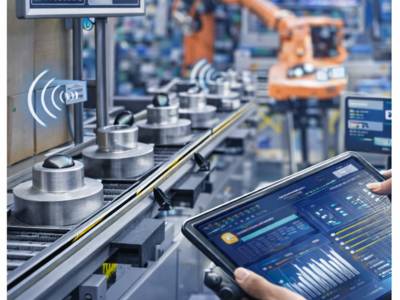
The most immediate application of RFID for production line operations is real-time work-in-progress (WIP) tracking. In complex assembly processes — automotive components, electronics boards, pharmaceutical batches — each unit carries an RFID tag that is read at every production stage. The system records which operations have been completed, which workstation performed them, and when — creating a fully automated production traveller without paper documentation.
Key outcomes for production line operations:
- Real-time WIP location visibility across all production stages
- Automated production sequence enforcement — preventing out-of-order assembly
- Instant identification of bottlenecks causing queue buildup at specific stations
- RFID for production line data integration with MES and ERP for live production dashboards
- Complete electronic batch records for pharmaceutical and food manufacturing compliance
2. Raw Material and Finished Goods Inventory Management
Effective inventory management factory India requires continuous, accurate visibility of raw material stocks, intermediate goods, and finished product inventory. Manual systems dependent on periodic physical counts create dangerous blind spots — production stoppages due to undetected raw material shortages, excess finished goods inventory consuming working capital, and shipment errors reaching customers.
RFID-based inventory management factory India systems provide real-time inventory data by reading tags automatically as materials move through goods-in, storage, production, and despatch. Inventory levels are updated continuously, triggering automated purchase orders when stocks fall below reorder thresholds and generating despatch documentation without manual data entry.
Operational benefits:
- Elimination of production stoppages caused by undetected raw material shortages
- Automated goods-in verification — confirming supplier shipment accuracy on receipt
- Real-time finished goods inventory for accurate order promising and despatch planning
- Reduction in warehouse labour costs through automated cycle counting
- Accurate inventory data for financial reporting, audit compliance, and working capital management
3. Asset Tracking in Manufacturing Plants
Asset tracking manufacturing plant operations is one of the highest-ROI RFID applications in industrial environments. Manufacturing plants contain thousands of tools, jigs, fixtures, moulds, and mobile equipment — all of which represent significant capital investment, require regular maintenance, and are prone to misplacement across large, multi-building facilities.
RFID-based asset tracking manufacturing plant systems tag every significant asset and monitor its location, usage, and maintenance status in real time. Tool crib management systems — where tools are issued and returned via RFID scan — eliminate tool loss, ensure maintenance schedules are followed, and prevent production downtime caused by missing or uncalibrated equipment.
What manufacturers gain from RFID asset tracking:
- Real-time tool and equipment location across the plant floor
- Automated tool issue and return recording at tool cribs
- Maintenance due alerts triggered by usage cycles rather than calendar schedules
- Prevention of unauthorised removal of high-value assets from production areas
- Accurate fixed-asset records supporting depreciation accounting and insurance valuation
4. Supply Chain Automation and Outbound Logistics
Supply chain automation RFID at the manufacturing end transforms goods despatch from a manual, error-prone process into an automated, verified operation. RFID readers at loading docks read every RFID-tagged pallet and carton as it is loaded onto vehicles — automatically generating despatch notes, updating customer order systems, and triggering advance shipment notifications (ASNs) without human data entry.
For manufacturers supplying large retail chains — where RFID compliance mandates from organisations like Reliance Retail, Walmart, and major apparel brands require RFID tagging at source — early adoption of supply chain automation RFID at the factory level provides a direct commercial advantage in supplier qualification and preferred-vendor scoring.
Supply chain automation benefits:
- Zero-error despatch verification — confirmed by RFID read, not visual check
- Automated ASN generation and system-to-system data exchange with customers
- Real-time in-transit visibility when combined with GPS-RFID hybrid tracking
- Returns processing automation — identifying returned products and updating inventory instantly
- Compliance with customer RFID tagging mandates for large retail and e-commerce clients
5. Pharmaceutical and Food Manufacturing Traceability
Regulated manufacturing sectors — pharmaceuticals, food processing, and medical devices — have the most stringent traceability requirements and the highest compliance risk. RFID provides the automated, immutable batch tracking that regulators demand. Every vial, blister pack, or food unit carries an RFID label recording its batch number, production date, expiry date, and production line — enabling instant, complete recall capability if a quality issue is identified at any stage.
In India, compliance with CDSCO (pharmaceutical) and FSSAI (food) traceability requirements, combined with global standards like GS1 and the US FDA Drug Supply Chain Security Act (DSCSA), makes RFID-based batch tracking not merely desirable but increasingly mandatory for export-oriented Indian manufacturers.
RFID in Manufacturing India: IoT Integration and Industry 4.0 Applications
The convergence of RFID with IoT sensor networks, AI analytics, and cloud manufacturing platforms — collectively called Industry 4.0 — represents the next frontier of RFID IoT integration manufacturing in India. RFID provides the identification and location layer; IoT sensors add environmental data (temperature, humidity, vibration); and AI analytics convert this combined data stream into predictive maintenance recommendations, quality forecasting, and autonomous supply chain decisions.
Predictive Maintenance with RFID and IoT
By combining RFID IoT integration manufacturing with vibration and temperature sensors on critical equipment, manufacturers can shift from scheduled maintenance — which either wastes resources by maintaining healthy equipment or fails to prevent unexpected breakdowns — to condition-based predictive maintenance that intervenes exactly when needed.
Digital Twin Integration
RFID-generated location and movement data feeds digital twin models of the production facility — virtual replicas of the factory floor that simulate process changes before physical implementation. This enables Indian manufacturers to optimise layouts, identify bottleneck patterns, and model the impact of new product introductions without disrupting live production.
Autonomous Mobile Robot (AMR) Coordination
Modern manufacturing facilities deploying autonomous mobile robots for material handling use RFID to identify tagged bins, components, and delivery destinations. RFID ensures that AMRs pick and deliver the correct items, integrating physical automation with the digital inventory system in real time.
4. Card Encoding Capabilities
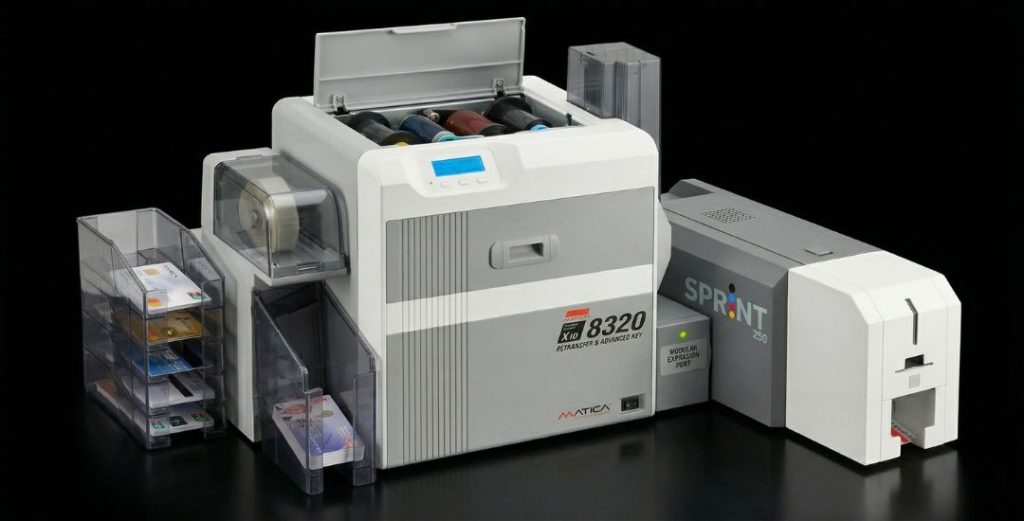
Modern PVC card printers can do far more than print — they can simultaneously encode smart card chips, magnetic stripes, and RFID antennas embedded within the card. An ID card printer with RFID encoding capability allows organisations to produce a combined printed and electronically encoded card in a single pass — delivering both the visual credential and the electronic identity in one operation.
Encoding options to evaluate:
Indian Manufacturing Industries Benefiting from RFID
Automotive Manufacturing
India’s automotive sector — led by Maruti Suzuki, Tata Motors, Mahindra, and component manufacturers in the ACMA network — uses RFID extensively for WIP tracking, just-in-time component sequencing, and vehicle identification throughout the assembly process. RFID windshield tags ensure correct vehicle routing at every station, while component tags verify assembly correctness and prevent mixed-part errors.
Pharmaceutical Manufacturing
India’s pharmaceutical export industry — the third-largest globally — uses RFID for batch traceability, serialisation compliance, and cold chain management. RFID vial tags and carton labels provide the item-level tracking required by US FDA and EU FMD regulations for exported drug products.
Textile and Apparel Manufacturing
Garment manufacturing and export facilities use RFID for cut-piece tracking, production line efficiency monitoring, and finished goods packing verification. RFID enables real-time visibility of order fulfilment progress across large contract manufacturing facilities.
FMCG and Food Processing
Consumer goods manufacturers use RFID for raw material lot tracking, production batch management, finished goods inventory, and distribution verification. RFID enables recall management and regulatory compliance for food and personal care products.
Electronics Manufacturing
Electronics manufacturers use RFID for PCB tracking through surface-mount technology (SMT) lines, component reel management, and final assembly verification. RFID prevents production errors in high-mix, low-volume electronics assembly operations.
RFID in Manufacturing India: Why Choose Salvonic for Industrial RFID Deployments?
When deploying RFID in demanding factory and supply chain environments, hardware reliability, environmental durability, and local support capability are non-negotiable. Salvonic’s Made-in-India RFID product range is built specifically to meet these requirements.
Salvonic offers:
- UHF RFID hard ABS tags and flexible tags for metal-surface asset and tool tracking
- UHF RFID windshield tags for vehicle and equipment identification in plant environments
- UHF RFID paper labels and wet inlay tags for carton, pallet, and component labelling
- BOLT 61 and BOLT 62 handheld UHF readers for mobile inventory audits and goods-in verification
- FLASH integrated fixed UHF readers for dock portals, production line gates, and goods receipt
- FLASH Smart integrated reader for embedded fixed-point identification in automated systems
- DASH desktop UHF reader for back-office tag encoding and verification
- Technical support from hardware installation through MES/ERP integration
By partnering with Salvonic, Indian manufacturers gain a domestic RFID hardware partner with deep industry expertise, competitive pricing driven by local manufacturing, and the agility to support phased deployments from pilot to plant-wide scale.
Why Choose Salvonic for Your PVC Card Printer Requirement?
When evaluating a card printer purchase, working with a manufacturer that combines product quality, local manufacturing, comprehensive consumables supply, and technical support provides a decisive advantage over importing equivalent hardware.
Salvonic offers:
- Object - India's first Made-in-India PVC card printer, purpose-built for the Indian market
- Matica XID 8300, XID 8600, and XPS printers - covering mid-range and enterprise card issuance needs
- Full range of genuine printer ribbons - YMCKO, YMCKOK, K, KO, HYMCKO, HYMCKOKO, White, Metallic Gold, Metallic Silver
- Printer cleaning kits to maintain printhead life and output quality
- Complete card range - plain white PVC, Mifare, proximity (thin/thick), chip, sticky, and RFID cards
- Printer driver downloads and technical support directly from the manufacturer
- Local service support from Salvonic's team at Okhla Industrial Area, New Delhi
By choosing Salvonic, organisations invest in a domestic RFID and card printing ecosystem that reduces import dependency, supports Make in India, and delivers the responsiveness that only a locally present manufacturer can provide.
Advantages of In-House PVC Card Printing for Indian Organisations
- Complete control over card design, data security, and issuance timing
- Lower long-term cost per card compared to outsourced third-party printing
- Instant card replacement capability — lost or damaged cards replaced same day
- Consistent brand presentation across all credentials and access cards
- Elimination of vendor dependency and minimum-order constraints
- Compliance with data privacy requirements — employee and student data never leaves the organisation
The advantages of in-house card printing extend beyond cost savings. For organisations in regulated industries — banking, healthcare, education, and government — maintaining control of the ID card production process is a governance imperative, not merely a convenience.
Conclusion
Selecting the right PVC card printer India for your organisation in 2026 requires a clear understanding of your print volume, card type requirements, encoding needs, and total cost of ownership. Whether you are a small office issuing basic employee IDs or a large institution managing thousands of student and access credentials, there is a printer specification that precisely matches your needs and budget.
This card printer buying guide has covered the full spectrum — from understanding print technologies and ribbon types to evaluating PVC card printing machine price tiers and following a structured selection framework. For organisations planning to upgrade to RFID-enabled access control, an ID card printer with RFID encoding capability future-proofs your investment. And for day-to-day office ID printing, a reliable ID card printer for office use like the Salvonic Sprint 230 delivers professional results at a cost accessible to any organisation.
Organisations looking for the best ID card printer India has to offer — backed by local manufacturing, comprehensive consumables supply, and genuine technical support — can confidently partner with Salvonic for their complete card printing and identity management requirements.
Frequently Asked Questions
What is the best PVC card printer for Indian businesses in 2026?
The best ID card printer India businesses can choose depends on volume and encoding requirements. For standard office ID card printing, the Salvonic Sprint 230 — India’s first Made-in-India PVC card printer – offers reliable performance, accessible pricing, and locally available consumables and support. For higher volumes or encoded cards, the Matica XID 8300 or XID 8600 may be more appropriate.
What is the price range for a PVC card printer in India?
PVC card printing machine price in India ranges from approximately ₹25,000–₹50,000 for entry-level direct-to-card printers suitable for offices and schools, to ₹50,000–₹1,50,000 for mid-range dual-sided and encoding models, and above ₹1,50,000 for enterprise retransfer printers used in banking and government card issuance programmes.
What is a card printer buying guide and why is it important?
A card printer buying guide helps organisations systematically evaluate print technology, print speed, encoding capability, ribbon types, consumables cost, and vendor support before purchasing. Without a structured evaluation, buyers often over- or under-specify their printer, resulting in either unnecessary cost or inadequate performance for their actual card issuance requirements.
What is an ID card printer for office use and what features should it have?
An ID card printer for office use should offer 300 DPI print resolution, USB or network connectivity, compatibility with standard YMCKO ribbons, and a print speed of at least 150–200 cards per hour. For offices that also manage access control, RFID or magnetic stripe encoding capability adds significant value without a major price premium.
Can a PVC card printer encode RFID cards as well?
Yes. An ID card printer with RFID encoding module can print and encode contactless RFID credentials in a single pass — simultaneously producing the visual card design and writing the electronic data to the embedded chip. This is particularly valuable for access control, attendance, and cashless payment programmes where a single card serves multiple functions.
What is asset tracking in manufacturing plants and why is it important?
Asset tracking in manufacturing plants involves monitoring the location, status, and usage of machinery, tools, and equipment using technologies like RFID. It helps improve operational efficiency, reduce equipment loss, minimize downtime, and ensure better inventory control. By implementing asset tracking systems, manufacturers gain real-time visibility, streamline workflows, and make data-driven decisions to optimize production and maintenance processes.
Ready to Find the Right PVC Card Printer for Your Organisation?
Partner with Salvonic to explore India’s widest range of PVC card printers, ribbons, and card stock — with local manufacturing, genuine consumables, and dedicated technical support.
👉 Request a Consultation
👉 Explore Salvonic Card Printers
👉 Download Driver for Sprint 230