RFID in Education India: How Schools & Universities Use RFID for Student ID, Library & Attendance
RFID in education India is transforming how schools, colleges, and universities manage student identities, library resources, and daily attendance — replacing manual processes, paper registers, and barcode-based systems with instant, contactless, and fully automated identification. From a Class 5 student tapping a Mifare card at the library counter to a university turnstile verifying student entry at 7 AM, RFID is quietly becoming the operating backbone of modern Indian educational campuses. This comprehensive guide explains exactly how RFID is being deployed in Indian educational institutions, what benefits it delivers, and what hardware is needed to build a complete smart campus system.
RFID in Education India: Why the Education Sector Is Rapidly Adopting Contactless Technology
The case for RFID in education India begins with a simple operational reality: Indian schools and universities are large, high-traffic environments that handle thousands of individual identity verification events every single day. A college with 5,000 students generates over 10,000 entry and exit events on a typical weekday — at gates, library counters, laboratory doors, examination halls, and hostel entrances. Managing this volume accurately and in real time with manual methods is not just inefficient; it is statistically impossible without significant errors, delays, and security gaps.
The nationwide push toward digital education infrastructure — driven by the National Education Policy (NEP 2020), the PM e-VIDYA programme, and institution-level NAAC accreditation requirements — has accelerated the adoption of technology-first campus management. RFID systems, with their plug-and-play compatibility with existing card printers, access control platforms, and student information systems, have emerged as the most cost-effective and fastest-to-deploy smart campus technology available to Indian educational institutions today. India’s leading card printer and RFID solutions
Student ID Card RFID: Building the Smart Student Credential
The foundation of any RFID campus system is the student ID card RFID credential — a standard CR80 PVC card printed with the student’s photograph, name, roll number, and course, with a Mifare contactless chip encoded with their unique campus identity. Unlike a barcode ID card that requires line-of-sight scanning, an RFID student card is read instantly when the student walks through a gate or presents it within a few centimetres of a reader — no removal from a lanyard or bag required in proximity card deployments.
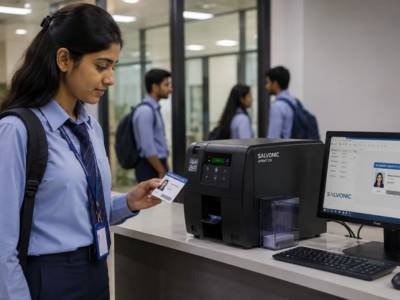
Salvonic‘s card printers — the Sprint 230 and the Matica XID 8300 — produce professional student ID card RFID credentials in a single pass, simultaneously printing the student’s photo and details on the card face while encoding the Mifare chip with the campus identity data. This single-pass issuance capability makes Salvonic card printers the preferred choice for universities issuing thousands of student cards at the start of each academic year. Smart card printers for educational institutions
A typical student ID card RFID system for a mid-sized campus uses Mifare Classic 1K or 4K cards — allowing the same card to serve multiple campus functions simultaneously: gate access, library borrowing, examination hall entry, cashless canteen payment, and hostel door access. smart campus
RFID Library Management System India: Automating Book Borrowing, Returns & Stocktaking
India’s educational libraries — from government school book banks to IIT and IIM research libraries housing millions of volumes — are transforming their operations with RFID library management system India deployments. Traditional library operations require staff to manually scan each book barcode at borrowing and return, conduct annual stocktakes that take weeks, and manually track overdue items. RFID eliminates every one of these bottlenecks simultaneously.
In an RFID-enabled library, every book carries a flat adhesive Salvonic UHF RFID library tag mounted inside the cover. When a student approaches the self-checkout kiosk, the system reads all books in the stack simultaneously — borrowing is completed in under 10 seconds without staff intervention. Returns are equally instant. library automation Annual stock takes that previously required a week of manual scanning can be completed by a single staff member with a Salvonic BOLT 61 handheld reader walking through the stacks in a single afternoon.
The RFID library management system India market is growing rapidly across Central University, state university, and private engineering college campuses — driven by UGC guidelines on digital library infrastructure and NAAC accreditation criteria that reward technology adoption. Salvonic UHF RFID library tags and handheld readers Salvonic’s library tags are ISO 15693 compliant and compatible with all standard library management software used in Indian institutions, including Koha, SLIM21, and New Gen Lib. contactless student card
Key benefits of an RFID library management system India deployment: self-checkout reduces queue times by 80%, stocktaking time drops from days to hours, and staff are freed from repetitive scanning to provide genuine reader assistance and collection development. nfc student id
RFID Attendance System India: Ending Proxy Attendance and Manual Registers for Good
Proxy attendance — where students mark absent classmates as present — is a persistent problem in Indian colleges and universities, undermining academic discipline and making attendance data unreliable for scholarship eligibility, examination permissions, and UGC compliance reporting. An RFID attendance system India solves this problem definitively by linking the physical RFID card to a biometrically verified student identity at the point of enrolment — making proxy attendance structurally impossible without physical card transfer, which is immediately detectable.
In an RFID attendance deployment, readers mounted at classroom doors or installed on each bench read student cards as they take their seats. Attendance is marked instantly and uploaded to the college’s student information system in real time. student tracking system. Faculty receive a live attendance dashboard on their phone or tablet — no paper register, no manual entry, no reconciliation errors. Parents can be notified automatically by SMS if a student fails to attend a class, adding a layer of accountability that paper systems cannot provide.
The RFID attendance system India integrates seamlessly with existing ERP platforms like Fedena, Campus 365, and Extramarks — enabling automatic attendance reports for UGC compliance, scholarship disbursement eligibility verification, and end-of-semester grade release gates. RFID access control and attendance solutions Salvonic’s BOLT and DASH readers provide the hardware backbone for both classroom-mounted and mobile RFID attendance deployments. Biometric alternative
RFID for Schools India: From Security Gates to Smart Canteens — A Full Campus Ecosystem
While colleges and universities are the primary deployers of campus RFID systems, RFID for schools India is growing rapidly across CBSE, ICSE, and state board schools — driven primarily by parent demand for child safety and real-time tracking. School RFID deployments typically combine entry/exit gate readers with an automated parent notification system that sends an SMS when a child enters or exits the school premises.
Beyond safety, RFID for schools India systems support cashless canteen payments (eliminating the risk of children losing cash), library management for school book banks, and school bus tracking using RFID tags that log when children board and exit their assigned vehicles. cashless canteen rfid The same student ID card — printed by a Salvonic card printer and encoded with a Mifare chip — serves all these functions simultaneously, making RFID the most comprehensive identity infrastructure investment a school can make.
For government schools participating in mid-day meal programmes, attendance data from RFID systems can be directly integrated with meal dispensing — ensuring that only present students receive meals, reducing wastage, and providing auditable data for government compliance. Mifare smart cards for campus management Salvonic supplies the full ecosystem – Mifare 1K/4K cards, BOLT readers, and Sprint 230 card printers — to support complete school RFID deployments.
How RFID in Education India Works: The Technology Architecture
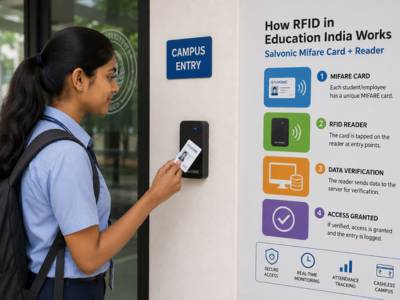
A complete RFID in education India deployment has five interconnected components working in real time:
- RFID Credential (Student Card): Mifare 1K or 4K card printed with student photo ID and encoded with unique campus identity — issued by the institution using a Salvonic card printer at the time of enrolment.
- RFID Readers: Fixed readers at gates and classroom doors (Salvonic FLASH integrated readers for high-throughput gates, DASH desktop readers for library counters), and handheld readers (Salvonic BOLT 61/62) for mobile inventory and stock verification tasks.
- Access Controller: Processes reader output, checks credentials against the authorisation database, and sends unlock/deny signals to gates, turnstiles, and door locks.
- Campus Management Software: Integrates RFID event data with the student information system — generating attendance reports, library records, meal logs, and access audit trails automatically.
- Card Personalisation System: The Salvonic Sprint 230 or Matica XID card printer with encoding module simultaneously prints and encodes each student card in under 30 seconds per card.
This integrated architecture means a single card serves as student photo ID, library card, attendance device, gate access credential, and cashless payment instrument – delivering the complete smart campus experience at a cost that is accessible even to mid-sized private schools and government degree colleges.
Salvonic Products for RFID in Education India
Salvonic provides the complete hardware ecosystem for RFID in education India deployments — from the card that the student carries to the reader at every access point:
- Mifare Classic 1K / 4K / 8K / 64K cards — for student ID, library, attendance, and multi-application smart campus credentials
- Proximity cards (thin and thick) — for legacy 125 kHz reader infrastructure in existing school access control systems
- UHF RFID library tags — flat adhesive tags for book and library asset tagging
- UHF RFID wristband tags — for hospital-style student identification in special needs schools and healthcare campus programmes
- Matica XID 8300 — dual-sided retransfer printer with encoding for premium university credential programmes
- BOLT 61 / BOLT 62 handheld readers — for library stocktaking, classroom attendance on the move, and campus inventory audits
- FLASH integrated fixed readers — for high-throughput campus gate portals and examination hall access
Conclusion
RFID in education India is no longer a future technology — it is an actively deployed, commercially proven infrastructure that hundreds of Indian educational institutions are building today. From the Sprint 230 card printer issuing student credentials to the FLASH reader verifying access at the university gate, every component of a smart campus ecosystem is available, affordable, and supported domestically through Salvonic. The question is no longer whether to adopt RFID in education — it is how quickly your institution can make the transition.
FAQs About RFID in Education India
What is RFID in education India and how does it work in schools?
RFID in education India uses Radio Frequency Identification technology to automate student identity verification, library management, and attendance tracking in schools and universities. Each student is issued an RFID-embedded card that communicates wirelessly with readers mounted at gates, library counters, and classroom entrances — recording attendance, authorising access, and enabling library transactions without any manual scanning or physical contact.
What type of RFID card is used for student ID in India?
The most widely used student ID card RFID credential in Indian educational institutions is the Mifare Classic 1K or 4K card — a 13.56 MHz contactless smart card that is compatible with virtually all access control readers, library management systems, and attendance platforms deployed across Indian campuses. Salvonic supplies Mifare 1K, 4K, 8K, and 64K cards, along with Sprint 230 and Matica XID card printers to simultaneously print the student’s photo and encode the chip.
How does an RFID library management system work in India?
An RFID library management system India works by tagging every book with a flat RFID label and equipping the library counter with a reader. When a student places books on the self-checkout platform, the system reads all RFID tags simultaneously and marks the books as borrowed against their student account — without any manual barcode scanning. Returns are equally instant. Annual stocktakes use a handheld reader walked through the stacks, completing in hours what previously took days.
Can RFID solve proxy attendance in Indian colleges?
Yes – an RFID attendance system India makes proxy attendance structurally very difficult because it requires the physical RFID card, which is linked to a specific student’s biometrically verified identity at enrolment. A student cannot transfer their card without it being immediately visible to faculty and security staff. The attendance system timestamps every card read, creating an immutable audit trail that cannot be manually altered — unlike paper registers.
What is the cost of implementing RFID for schools in India?
The cost of deploying RFID for schools India depends on the scale of deployment. A basic gate access and attendance system for a 500-student school requires a card printer (Salvonic Sprint 230, approximately ₹30,000–₹50,000), RFID readers for each gate (₹15,000–₹40,000 per reader), student cards (approximately ₹30–₹80 per Mifare card), and campus management software. Total infrastructure cost for a complete school deployment typically ranges from ₹2–₹8 lakhs depending on the number of access points and features.
Is RFID or biometric better for student attendance in India?
Both technologies have merits, but RFID offers several advantages for educational campus environments. RFID reads are faster (under 100 milliseconds vs. 2–5 seconds for fingerprint), work reliably regardless of skin condition or wet hands (a common issue in India’s humid climate), and the same RFID card serves multiple campus functions simultaneously — library, attendance, canteen, and access control. The RFID attendance system India is also significantly more hygienic for post-pandemic environments where contactless operation is preferred.
Ready to Build a Smarter Campus with RFID in Education India?
Whether you are a school principal issuing 500 student ID cards or a university administrator deploying campus-wide access control for 20,000 students, Salvonic has the complete hardware ecosystem – Mifare cards, RFID readers, and Made-in-India card printers – to make your smart campus vision a reality.