RFID in Healthcare India

RFID in Healthcare India: Patient Safety and Asset Tracking

What is RFID in Healthcare?

RFID in healthcare India refers to the application of Radio Frequency Identification technology inside hospitals, clinics, diagnostic centres, and pharmaceutical facilities to automate the tracking of patients, medical assets, surgical instruments, and clinical inventory in real time. By attaching RFID tags to wristbands, equipment, or medicine packages, healthcare providers gain instant visibility over everything that moves within their facility — without manual scanning or paperwork.

Companies like Salvonic, a leading Indian manufacturer of RFID tags and readers, help healthcare organisations deploy reliable, locally built RFID systems that integrate seamlessly with hospital information platforms and ERP systems.

Understanding how this technology is transforming patient safety, equipment utilisation, and clinical operations is essential for hospital administrators, procurement heads, and healthcare technology decision-makers across the country.

RFID in Healthcare India: Introduction

Introduction

India’s healthcare sector is undergoing rapid digital transformation. With over 70,000 hospitals and lakhs of diagnostic facilities nationwide, the challenge of managing patients, assets, and medication safely and efficiently has never been greater. The India healthcare RFID market is projected to grow at a CAGR of 20.9% through 2030, reaching USD 672 million — driven by hospital infrastructure investment, patient safety mandates, and the push toward smart hospital models.

Institutions like the All India Institute of Medical Sciences (AIIMS) have already begun integrating RFID into their operational workflows, setting the precedent for nationwide adoption. The Government’s National Health Policy and Ayushman Bharat Digital Mission further accelerate technology investment across public and private hospitals alike.

This guide covers the key use cases of RFID technology in Indian hospitals — from hospital asset tracking RFID programmes and patient tracking system India deployments to pharmaceutical inventory control — and how manufacturers like Salvonic support end-to-end implementation. It also covers key RFID in hospitals India 2025 adoption trends shaping the sector.

RFID in Healthcare India: Key Applications and Use Cases

1. Patient Tracking and Safety Management

Real-time patient identification and movement tracking is one of the most impactful applications of RFID technology in Indian hospitals. RFID wristbands issued at admission carry a unique tag linked to the patient’s complete medical record — diagnosis, allergies, prescribed medication, and treating physician. At every touchpoint — ward entry, operating theatre, pharmacy, radiology — the wristband is read automatically, ensuring that the right care is delivered to the right patient, every time.

A robust patient tracking system India hospitals are deploying prevents critical errors such as wrong-patient medication, surgical misidentification, and transfusion mix-ups. In large multi-speciality facilities where hundreds of patients move across departments daily, RFID patient tracking eliminates the manual identification failures that barcode or paper-based systems cannot fully prevent.

Key benefits for patient safety:

2. Hospital Asset Tracking RFID and Equipment Management

Hospital asset tracking RFID is one of the most financially justified use cases for Indian hospitals. Medical equipment — infusion pumps, ventilators, ECG machines, wheelchairs, and surgical instruments — represents crores of rupees in capital investment, yet significant staff time is lost daily searching for misplaced devices.

Effective RFID for medical equipment management resolves this by tagging every significant asset, allowing the hospital’s tracking system to display real-time equipment location on a digital floor map. Maintenance schedules, calibration records, and sterilisation cycles are automated, triggering alerts when equipment is overdue for service or when a high-value asset moves outside an authorised zone.

What hospitals gain from RFID asset tracking:

3. Pharmaceutical Tracking and Inventory Management

Medication management is among the most regulation-sensitive areas of hospital operations. Dispensing errors, expired stock, and counterfeit drugs represent serious patient safety risks and legal liabilities. RFID-based healthcare inventory management RFID systems address all three simultaneously by tagging individual medicine packages, vials, and blood bags with RFID labels that are read automatically at procurement, storage, dispensing, and administration.

For blood banks, RFID wristbands and tagged blood bags create a closed-loop verification system that prevents potentially fatal transfusion errors. For vaccine cold chains, RFID combined with temperature sensor tags ensures biologics remain within required storage conditions throughout distribution. This level of end-to-end traceability is what makes healthcare inventory management RFID a compliance necessity as much as an operational upgrade.

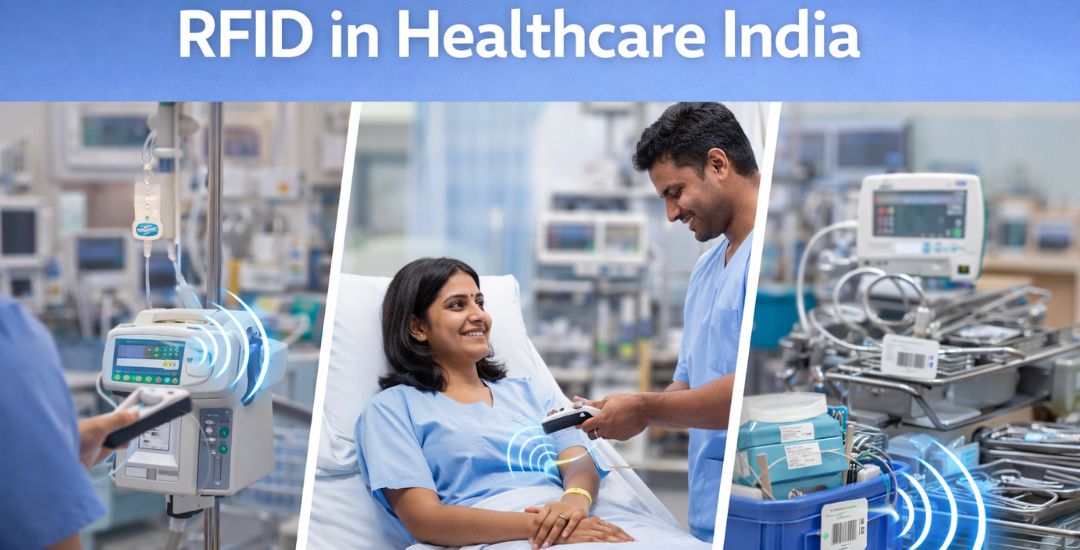
RFID in healthcare India improving patient tracking system India and healthcare inventory management RFID
RFID in healthcare India enabling hospital asset tracking RFID and RFID for medical equipment management

RFID delivers the following in pharmacy and inventory:

4. Surgical Instrument Tracking and Sterilisation Management

Retained surgical instruments — items accidentally left inside a patient’s body after a procedure — are among the most severe and preventable adverse events in healthcare. RFID-tagged instruments provide operating theatre teams with an automated count system that verifies every item before and after each procedure, eliminating the risk of retained foreign objects.

Beyond the theatre, RFID tracks instruments through the central sterile supply department (CSSD), logging each sterilisation cycle, usage history, and instrument condition. This directly supports compliance with NABH and JCI accreditation standards and protects hospitals from medico-legal liability.

How RFID in Healthcare India Works: Technology Overview

Understanding how RFID systems function in clinical environments helps hospital technology teams plan deployments that deliver maximum benefit with minimum disruption.

RFID Tags

Passive or active RFID tags are attached to patients (wristbands), medical assets (hard tags), or medicine packaging (paper/flexible labels). Each tag carries a unique Electronic Product Code (EPC) linked to the relevant record in the hospital’s information system.

Fixed readers installed at doorways, ward entrances, and key chokepoints automatically capture tag data as tagged items pass through. Handheld readers are used by clinical staff for on-demand audits, equipment checks, and medication verification at the point of care.

RFID middleware filters raw tag reads, removes duplicates, and pushes clean, real-time data to the Hospital Information System (HIS), Electronic Medical Records (EMR), and ERP platforms — creating an automated data flow without manual entry.

The integrated system generates automated alerts for unauthorised movement, missing assets, expiring inventory, or incomplete instrument counts — providing the operational intelligence clinical teams need for faster, safer decisions.

Salvonic’s product range — including the BOLT 61 and BOLT 62 handheld UHF RFID readers for mobile clinical use, the FLASH fixed integrated readers for doorway and ward monitoring, and a comprehensive range of UHF RFID tags including wristband tags, vial tags, and flexible labels — provides hospitals with a complete, locally manufactured hardware ecosystem for any scale of RFID deployment.

RFID in Healthcare India: Adoption Trends and Current Landscape in 2025

The landscape of RFID in hospitals India 2025 is defined by accelerating adoption across both public and private healthcare, driven by regulatory pressure, quality accreditation requirements, and cost reduction imperatives. Here are the key trends shaping hospital RFID deployment this year.

NABH and JCI Accreditation Driving RFID Adoption

National Accreditation Board for Hospitals (NABH) and Joint Commission International (JCI) standards mandate robust patient identification, medication safety, and equipment management protocols. RFID-based systems satisfy many of these requirements with automated, auditable records — making hospital asset tracking RFID a compliance investment as much as an operational one.

The Pradhan Mantri Swasthya Suraksha Yojana and AIIMS expansion programme are driving capital investment into large public hospitals. AIIMS Delhi and AIIMS Bhopal have integrated RFID into asset tracking and patient management workflows, establishing a replicable model for other government institutions across India.

Leading private hospital chains — Apollo, Fortis, Manipal, and Narayana Health — are deploying RFID in hospitals India 2025 programmes across their networks to standardise operational protocols, reduce losses from equipment misplacement, and improve patient experience scores through faster, more accurate care delivery.

Hospitals are converging RFID with IoT sensor networks and AI-driven analytics to move from reactive tracking to predictive management. Real-Time Location Systems (RTLS) powered by active RFID or hybrid passive-active architectures are enabling facility-wide asset and patient intelligence — representing the next frontier for RFID for medical equipment management and clinical workflow optimisation in Indian hospitals.

Why Choose Salvonic for Healthcare RFID Solutions?

When implementing hospital RFID infrastructure, choosing a hardware partner with deep RFID expertise, a locally manufactured product range, and strong post-deployment support is critical. Salvonic offers a complete portfolio of Made-in-India RFID products purpose-built for demanding clinical environments.

Salvonic offers:

By partnering with Salvonic, hospitals gain not just RFID hardware — but a complete clinical identification ecosystem designed for Indian healthcare environments, regulatory standards, and operational realities.

Key Benefits of RFID Technology Across Hospital Departments

Clinical Benefits

Conclusion

The adoption of RFID technology is rapidly moving from a pilot-stage initiative to a mainstream operational standard across Indian hospitals and healthcare facilities. From accurate patient tracking system India deployments that prevent critical care errors, to comprehensive hospital asset tracking RFID programmes that eliminate equipment loss — every application delivers measurable gains in patient safety, efficiency, and financial performance.

From precision RFID for medical equipment management in ICUs and OTs, to end-to-end healthcare inventory management RFID in pharmacies and blood banks — each layer of RFID deployment builds toward a fully connected, intelligent hospital environment. As RFID in hospitals India 2025 adoption accelerates across public institutions and leading private groups alike, organisations that invest in robust RFID infrastructure now will lead India’s next generation of smart healthcare delivery.

Organisations ready to begin their RFID healthcare journey can partner with Salvonic — India’s trusted RFID hardware manufacturer — to deploy scalable, reliable, and clinically validated systems tailored to every hospital’s unique operational requirements.

Frequently Asked Questions

What is RFID in healthcare and how is it used in Indian hospitals?

RFID in healthcare involves using Radio Frequency Identification to track patients, medical assets, instruments, and pharmaceutical inventory in real time. Indian hospitals use RFID wristbands for patient identification, hard tags for equipment monitoring, and RFID labels for medicine verification — improving safety, reducing errors, and streamlining clinical operations.

Hospital asset tracking RFID works by attaching UHF RFID tags to medical equipment. Fixed readers at key locations and handheld readers used by staff automatically capture tag data and display real-time equipment location on a digital floor plan. Alerts are triggered for unauthorised movement, missed maintenance, and missing assets.

In the context of RFID in hospitals India 2025 adoption, AIIMS Delhi and AIIMS Bhopal have integrated RFID into patient management and asset tracking. Leading private groups including Apollo, Fortis, and Narayana Health are deploying RFID programmes across their networks for operational standardisation and patient safety compliance.

Healthcare inventory management RFID systems tag individual medicine packages, vials, and blood bags — enabling automated stock counting, real-time expiry monitoring, complete dispensing audit trails, and anti-counterfeit verification. This eliminates the inefficiencies and patient risks of manual pharmacy inventory management entirely.

Salvonic offers a full range for RFID for medical equipment management and patient safety — including UHF RFID wristband tags, vial tags, paper and flexible labels, hard metal-surface tags, the BOLT 61 and BOLT 62 handheld readers, FLASH integrated fixed readers, and DASH desktop readers. All products are Made in India, backed by full installation and integration support.

Ready to Transform Your Hospital’s Operations with RFID?

Partner with Salvonic to deploy industry-grade RFID solutions for patient safety, asset tracking, and healthcare inventory management across your facility.

👉 Request a Consultation

👉 Explore Salvonic Healthcare RFID Products

👉 Get a Custom Hospital Deployment Plan